

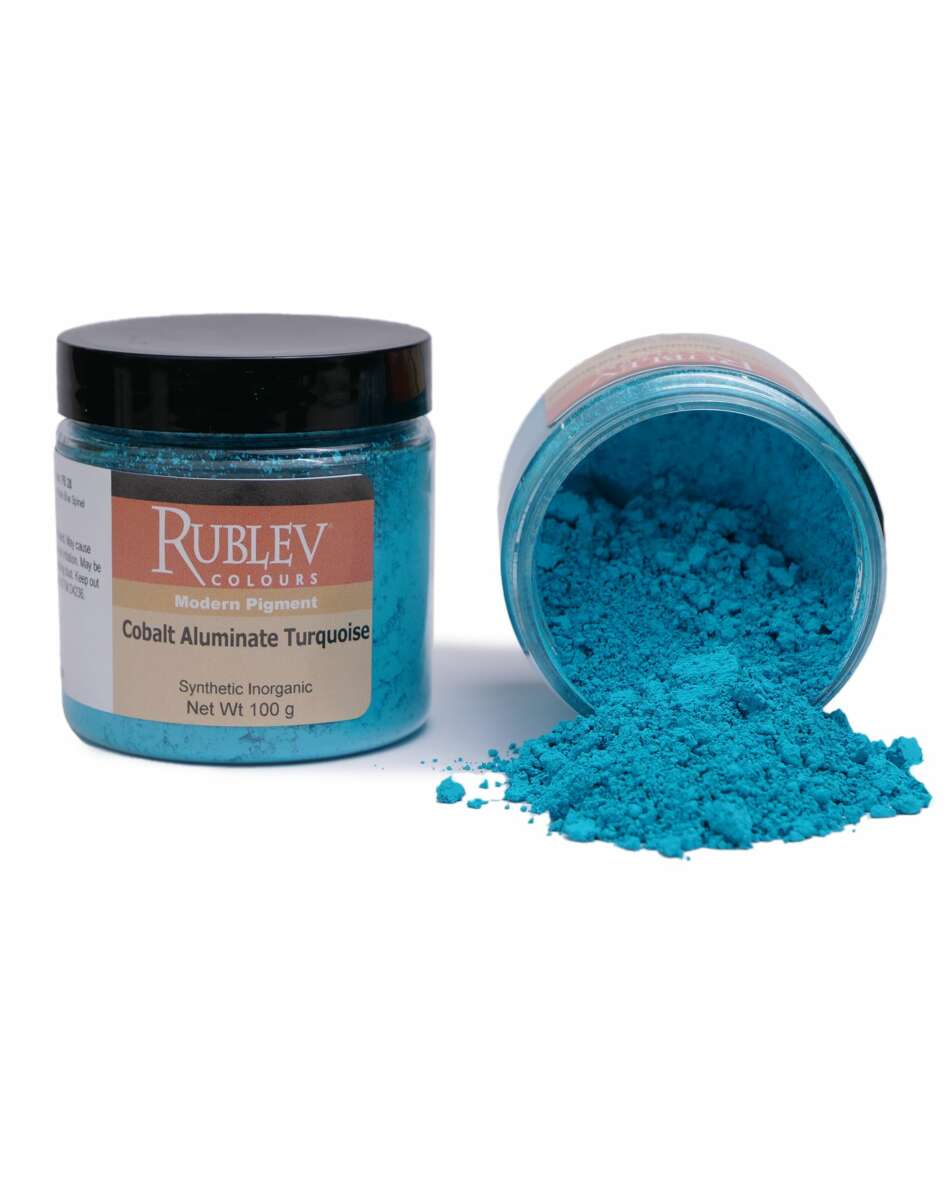
Cobalt Turquoise Pigment
Cobalt Turquoise pigment is cobalt aluminate blue spinel (CoAl2O4) produced by calcining, at high temperature, a mixture of cobalt (II) oxide, and aluminum (III) oxide in varied ratios forming an interdiffused crystalline spinel. It may include any one or more modifiers MgO, ZnO, Li2O and/or TiO2.
Cobalt Turquoise pigment is cobalt chromite blue-green spinel (Co[Al,Cr]2O4). It is a blue-green powder produced by solid-state reactions at a very high temperature. It is lightfast, alkali, acid, heat, and weather resistant. It was created to color concrete, stucco, and grout but is excellent in artists' painting mediums. It is also compatible with ceramic bodies and low zinc glazes.
Cobalt Turquoise is made by calcining at 2400°F a mixture of cobalt (II) oxide, chromium (III) oxide, and aluminum (III) oxide in varied ratios, forming an interdiffused crystalline spinel matrix. Its constitution may also include one or more modifiers, zinc oxide (ZnO), manganese oxide (MgO), silicon dioxide (SiO2), titanium dioxide (TiO2), or zirconium dioxide (ZrO2) to adjust color hue or other properties. Cobalt blue pigments are the most durable blue pigments commercially available. They have excellent chemical and heat stability and can be used in chemically aggressive environments and exterior durable applications without color fade.
Cobalt Turquoise pigment has good ultraviolet and visible light opacity and is chemically inert, heat resistant, and stable to ultraviolet light. It is non-bleeding and non-migratory. It has exceptional durability and hiding power and is generally used in applications where resistance to heat, light, and weather is needed. It is compatible with most resins and polymers and is non-warping. Typical applications (noninclusive) are liquid and powder coatings, inks, dispersions, concrete, plastics, and other applications where equivalent pigment chemistry is used.
This pigment is easily dispersed, does not need grinding, and can be stirred using most laboratory and production equipment to achieve complete dispersion.
| Pigment Names | |||||||
| Common Names (pigment): | English: cobalt chromite blue-green spinel French: spinelle bleu cobalt d'chromite German: Kobalt Cromit blauen Spinell Italian: cobalto cromito blu spinello Spanish: cobalto espinela de cromito azules | ||||||
| Nomenclature: |
| ||||||
| Pigment Information | |
| Color: | Blue Green |
| Pigment Classification: | Synthetic Inorganic |
| Colour Index: | Pigment Blue 36 (77343) |
| Chemical Name: | Cobalt Chromite Blue-Green Spinel |
| Chemical Formula: | Co(Al,Cr)2O4 |
| CAS No.: | 68187-11-1 |
| Series No.: | 5 |
| ASTM Lightfastness | |
| Acrylic: | I |
| Oil: | I |
| Watercolor: | I |
| Physical Properties | |
| Mean Particle Size: | 1.4 micrometers |
| Residue 325 mesh (44 µm): | 0.01 wt% |
| Surface Area BET: | 3.8 m²/g |
| Specific Gravity: | 4.8 |
| Density: | 4.8 g/cm3 |
| Bulk Density: | 0.49 kg/L |
| Refractive Index: | 1.560–1.662 |
| Heat Stability: | 800 °C |
| pH: | 8.6 |
| Oil Absorption: | 17 grams oil / 100 grams pigment |
| Health and Safety | No acute or known chronic health hazards are associated with this product's anticipated use (most chemicals are not thoroughly tested for chronic toxicity). Protect yourself against potentially unknown chronic hazards of this and other chemical products by keeping them out of your body. Do this by avoiding ingestion, excessive skin contact, and inhaling spraying mists, sanding dust, and vapors from heating. Conforms to ASTM D-4236. |
For a detailed explanation of the terms in the table above, please visit Composition and Permanence.
Origin and History
Cobalt aluminate is identified as the blue pigment on 30 polychromic shards of the 18th dynasty from Theben and Tell el Amarna. The spinel phase has a much lower cobalt/aluminum ratio than modern cobalt blue pigments. Probably it contains nickel and zinc, which were found by x-ray spectroscopy. Cobalt salts were first identified in the eighteenth century. The earliest modern history of cobalt aluminate pigments commences with Leithner in Vienna, who appears to have discovered the basic process of calcining cobalt oxide and alumina (aluminum oxide) in 1775. Techniques for manufacturing cobalt blue, the chemically pure salt of cobalt and aluminum oxide, were developed in 1802.
Source
Cobalt blue is cobalt aluminate blue spinel (Pigment Blue 28 or PB 28) with the chemical structure CoAl2O4. There are three basic modifications (Pigment Blue 36:1, Pigment Blue 36, and Pigment Blue 72) in which parts of the cobalt are substituted either alone or in combination with chromium and zinc. These variations differ in their tinting strength and hue.
| Cobalt Blue Pigment Family | ||
| Color | Formula | Color Index |
| Cobalt aluminate blue spinel | CoAl2O4 | Pigment Blue 28 |
| Cobalt chromite blue-green spinel | Co(Al,Cr)2O4 | Pigment Blue 36 |
| Zinc cobalt chrome aluminum spinel | (Zn,Co)(Cr,Al)2O4 | Pigment Blue 36:1 |
| Cobalt zinc aluminate spinel | (Co,Zn)Al2O4 | Pigment Blue 72 |
The basic cobalt blue color, Pigment Blue 28, is produced by high-temperature calcination of cobalt (II) oxide (CoO) and aluminum oxide (Al2O4). The variations are produced by partially substituting the cobalt with chromium and zinc, alone or in combination. The result is a large variety of cobalt blue pigments that differ in their tinting strength or hues (reddish or greenish blue), depending on the exact chemical composition. The lighter-colored cobalt blue is prepared by adding zinc (II) oxide to the ingredients used for the basic pigment, forming Pigment Blue 72. Blue-green hues are produced by introducing chromium (III) oxide, partially replacing the aluminum (III) oxide in the basic cobalt blue, forming Pigment Blue 36.
All of them form the crystalline modification of spinel during calcination. The spinels are a class of minerals that crystallize in the cubic (isometric) crystal system with the oxide anions arranged in a cubic close-packed lattice. The cations occupy some or all of the octahedral and tetrahedral sites in the lattice. Spinel minerals form octahedral crystals that are usually twinned. They have an imperfect octahedral cleavage and conchoidal fracture. The hardness of spinel minerals is around 8 (chalk has a hardness of 2-3), specific gravity is 3.5-4.1, and it is transparent to opaque with a vitreous to dull luster.
Permanence and Compatibility
All cobalt blue pigments are chemically inert and insoluble. They have good hiding power, excellent heat stability, and excellent lightfastness and weather resistance.
Water-Based Paint
Cobalt Turquoise is a semi-transparent pigment with moderate tinting strength in most water-based paints. When it dries, it appears lighter and less saturated. Although pigment particles are very fine, they flocculate, giving a grainy appearance in watercolor. Differences in how the pigment is ground and mixed lead to considerable differences in its performance.
Oil-Based Paint
Cobalt Turquoise is a semi-transparent pigment with moderate tinting strength in oil-based paint. Differences in how the pigment is ground and mixed can lead to considerable differences in appearance.
Oil Absorption and Grinding
Cobalt Turquoise absorbs a moderately high amount of oil, about 17 grams of linseed oil per 100 grams of pigment, to make a paste. It has been noted in some manuals that the pigment works better as a watercolor than it does in oil and is highly valued on that account among moist colors used by artists. Grinding it for artists' use in oil will require about 80 percent dry pigment to 20 percent by weight of poppy seed or walnut oil, either of which some artists prefer to linseed oil. Cobalt Turquoise has a greenish tone that is more or less reddish blue when viewed under incandescent light.
Toxicity
Cobalt Turquoise is not considered toxic; however, care should be taken when handling the dry powder pigment to avoid inhaling the dust. All toxicological studies showed no signs of toxicity to humans or the environment.
In animal studies, cobalt blue pigments did not display acute toxicity. No acute irritant effect was shown in tests to determine the acute irritation of skin and mucous membranes. No statistically significant results were found in studies on rats to determine the carcinogenic potential. Soluble cobalt compounds and cobalt metals may have a sensitizing effect. However, none have been reported during many years of handling cobalt blue pigments.
Cobalt Turquoise typically contains a total of the regulated metals lead, cadmium, mercury, and hexavalent chromium below the strictest specification of 100 ppm outlined in the Model Toxics in Packaging (CONEG) legislation.
EU Packaging - 94/62/EC (EU): Cobalt Turquoise typically contains a total of the regulated metals lead, cadmium, mercury, and hexavalent chromium below the strictest specification of 100 ppm outlined in the Council of Europe Directive 94/62/EC, on packaging and packaging waste.
List of the ELV, RoHS, and WEE Approved Pigments: Cobalt Turquoise meets the purity thresholds for lead, cadmium, mercury, and hexavalent chromium as specified in European Directives for the End of Life Vehicles (ELV), Restrictions on the use of hazardous substances in electrical and electronic equipment (RoHS) and Waste Electronic and Electrical Equipment (WEEE) as they are currently written.
List of TCLP Approved Pigments: Cobalt Turquoise pigment typically does not exhibit extractable contaminants above those listed in 40CFR 261.24, using the Toxic Characteristic Leaching Procedure, Method 1311, 40CFR 261 appendix II. Thus, this products are not considered toxic for disposal purposes.
Ecology
Since Cobalt Turquoise is inert and practically insoluble in water, it does not harm the environment. The pigment can be removed mechanically from effluents, and no dissolved heavy metals are released into the seepage water on controlled dump sites.
For more information on handling pigments safely, please visit How to Safely Handle Art Materials and Pigments.
| SKU | 417-25 |
|---|---|
| Brand | Rublev Colours |
| Vendor | Natural Pigments |
| Processing Time | Usually ships the next business day. |
| Color | Blue |
| Pigment Type | Inorganic, Synthetic |

