


Italian Brown Ocher Pigment
Our Italian Brown Ochre is from deposits in northern Italy. Our brown ocher pigment is finely ground and exhibits a reddish brown masstone. It has good tinting strength and covering power.
Our Italian Brown Ocher is from deposits in northern Italy. A yellow to brown hydrated iron oxide mineral is usually present in the oxidized portions of iron ore deposits. It is the most common constituent of many forms of iron oxide. Our brown ocher pigment is finely ground and exhibits a reddish brown masstone. It has good tinting strength and covering power.
| Pigment Names | |||
| Common Names: | English: brown ochre French: ocre brun German: Ocker Braun Italian: ocra marrone Japanese: 茶色の黄土色 Spanish: ocre marrón | ||
| Mineral Names: | English: Goethite French: Goethite German: Götheit Italian: Goetite Japanese: 針鉄鉱 Spanish: Goethita | ||
| Alternate Names: | brown hematite, brown ochre, goethite, yellow ochre (also spelled ocher) Mars Yellow and Mars Brown are names given to the artificial substitutes for goethite. | ||
| Nomeclature: |
| ||
Origin and History
Goethite was named for Johann Wolfgang von Goethe (1749–1832), a German philosopher and poet who also was a mineralogist. Goethite has been in continuous use as a pigment since prehistoric times. Evidence of goethite was found in paint pigment samples taken from the caves of Lascaux, France. In ancient Greece, "ochre" was used for natural earth pigments of different yellow hues (ocher light, golden, dark, greenish, etc.).
Source
This widespread mineral, consisting of hydrated iron oxide, is encountered practically everywhere on the earth's surface in the form of concretions, oolites (a form consisting of small round grains cemented together), reniform (kidney shapes), or botryoidal (a form resembling bunches of grapes) accumulations. It is frequently encountered in swampy areas at the head of spring waters and on the bottom of lakes and small creeks. Iron oxides, or earth pigments, as they often are called, are an essential group of inorganic pigments derived from minerals. Iron oxide pigments are yellow, red, brown, and green, but artists know them as ocher, sienna, red oxide, umber, and terra verte. Unlike pigments made in a laboratory, the color of natural iron oxide pigments varies with the composition of the particular segment of earth from which they come. The color of these pigments is derived from three constituents: the principal coloring ingredient, secondary coloring ingredients, and a base. The combination of these ingredients produces the particular color of the earth. The innumerable forms and variations these ingredients can combine result in a wide range of possible yellows, reds, browns, and greens.
Principal Colorant
Iron oxide is the principal color producing ingredient in the earth. The properties of the particular iron oxide in the earth determine its color. The nature of the iron oxide found in the deposit, rather than its percentage, is critical to the resulting earth color. Most rock contains some iron oxide. Those bearing the least amounts are limestone, white clay, and colorless kaolin. Those containing the highest amounts are the rocks from which metallic iron is extracted.
Secondary Colorants
Calcium, manganese oxide, carbonic materials, silica, and limestone are some common modifiers that affect the specific color of natural iron oxides. Manganese oxide, for example, enriches the brown in numbers.
Base
Nearly all iron oxides have a clay base. Clay is the weathered product of silicate rocks and is extremely varied in composition. As a result, it has numerous effects on the earth's color.
Our brown ocher or goethite is from deposits found in northern Italy in the Verona region. It is finely ground and has a reddish-brown masstone. It has excellent tinting strength and good covering power.
Tinting Strength
Relatively large crystals of goethite give the yellow color of this mineral, whereas smaller crystals produce shades of brown. As demonstrated in experiments conducted by K. I. Tolstikhinoy, the chromaticity of natural iron oxide and clay pigments are closely related to the content of iron oxide and, from a mineralogical point of view—the content of goethite. Thus, with the content of iron oxide less than 23%, luminosities of the tone of pigment compose 40–50%, and the purity of tone 60–70%. With the content of iron oxide from 22 to 74%, luminosities of tone varies in an interval of 25–40%, the purity of tone from 70 to 85%, and with the content of iron oxide more than 75%, luminosity is located in an interval of 18–25%, the purity of tone 83-90%.
Pigment Characteristics
A characteristic of pigments containing goethite is their ability to change color when heated. Heating ocher, sienna, and umber cause the hydrated iron oxide to give up water and darken in shade while its tone intensifies. At temperatures exceeding 300°C, yellow pigments acquire red-brown tones. The most intensive red tones are obtained from calcining goethite at a temperature between 500–600°C. The color change is directly related to the dehydration of goethite and its transformation into hematite. Prolonged heating at high temperatures causes another change into a mineral of dark gray color—magnetite.
Permanence and Compatibility
Goethite or brown ocher does not react with other pigments and is effectively used in fresco, oil, tempera, and watercolors. It is considered permanent with medium to good tinting strength and opacity. It does not react with solvents and is indifferent to alkalis but is partially soluble in acids.
Oil Absorption and Grinding
Brown ocher moderately absorbs oil when dispersing the dry pigment in this medium. The oil absorption ratio is 23–35 parts by weight of raw linseed oil to 100 parts by weight of pigment. If the measurement were grams, it would require 23 to 35 grams of linseed oil to grind 100 grams of pigment to form a stiff paste.
Toxicity
Brown ocher is not considered toxic.
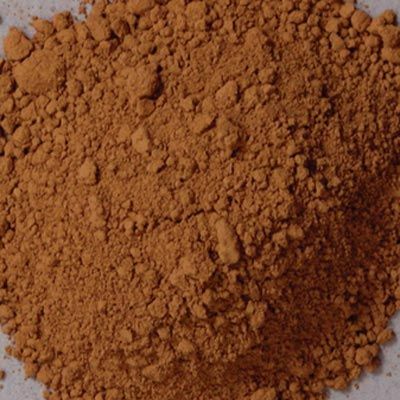
Pigment: Italian Brown Ocher (Goethite)
| Pigment Information | |
| Color: | Brown |
| Colour Index: | Pigment Brown 7 (77491) (77492) (77499) |
| Chemical Name: | Iron Oxide Hydrated (partial component) |
| Chemical Name: | FeO(OH) |
| ASTM Lightfastness Rating | |
| Acrylic: | I |
| Oil: | I |
| Watercolor: | I |
| Properties | |
| Density: | 3.3–4.3 |
| Hardness: | 5.0–5.5 |
| Refractive Index: | nα=2.260 nβ=2.393 nγ=2.398 |
| SKU | 461-50 |
|---|---|
| Brand | Rublev Colours |
| Vendor | Natural Pigments |
| Processing Time | Usually ships the next business day. |
| Color | Brown |
| Pigment Type | Inorganic, Earth, Natural |

