

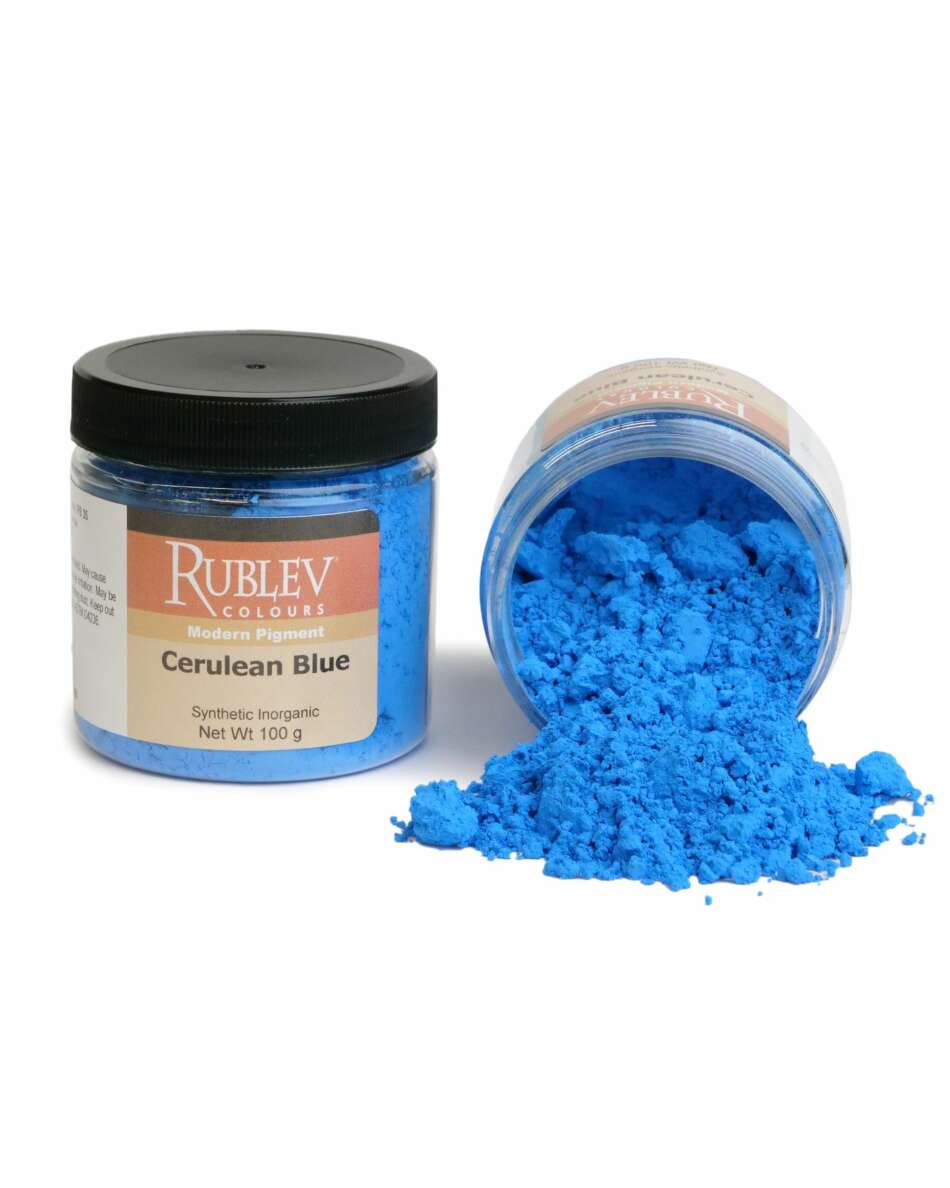
Rublev Colours Cerulean Blue Pigment - High-Quality, Durable Artistic Pigment
Rublev Colours Cerulean Blue pigment is composed of cobalt stannate. Cerulean blue is made by roasting cobalt and tin oxides. Cobalt blue pigments are the most durable blue pigments commercially available. They have excellent chemical and heat stability and can be used in chemically aggressive environments and exterior durable applications without color fade.
Rublev Colours Cerulean Blue pigment is composed of cobalt stannate. Cerulean blue is made by roasting cobalt and tin oxides. Cobalt blue pigments are the most durable blue pigments commercially available. They have excellent chemical and heat stability and can be used in chemically aggressive environments and exterior durable applications without color fade.
This pigment is easily dispersed, does not need grinding for dispersion in water-based paint binders, and can be stirred using most laboratory and production equipment to achieve complete dispersion.
| Pigment Names | |||||||||
| Common Names (pigment): | English: Cerulean blue | ||||||||
| Synonyms: | Azul Celeste | ||||||||
| Nomenclature: |
| ||||||||
| Pigment Information | |
| Color: | Blue |
| Pigment Classification: | Synthetic Inorganic |
| Colour Index: | Pigment Blue 35 (77368) |
| Chemical Name: | Cobalt(II) Stannate |
| Chemical Formula: | CoO.nSnO2 |
| CAS No.: | 1345-19-3 |
| Series No.: | 5 |
| ASTM Lightfastness | |
| Acrylic: | I |
| Oil: | I |
| Watercolor: | I |
| Physical Properties | |
| Particle Size (mean): | 1.0 microns |
| Density: | 4.7 g/cm3 |
| Refractive Index: | 1.84 |
| Oil Absorption: | 55 grams oil / 100 grams pigment |
| Health and Safety | No acute or known chronic health hazards are associated with this product's anticipated use (most chemicals are not thoroughly tested for chronic toxicity). Protect yourself against potentially unknown chronic hazards of this and other chemical products by keeping them out of your body. Do this by avoiding ingestion, excessive skin contact, and inhaling spraying mists, sanding dust, and vapors from heating. Conforms to ASTM D-4236. |
For a detailed explanation of the terms in the table above, please visit Composition and Permanence.
Origin and History
The name “Cerulean blue” comes from the Latin caeruleus meaning dark blue caelum, which in turn probably derives from caelulum, diminutive of caelum, “heaven sky”.
Cerulean blue is cobalt stannate introduced as a pigment in the 1860s. Very stable and lightfast greenish-blue with limited hiding power. Cerulean blue has a fairly true blue (not greenish or purplish) but doesn't have the opacity or richness of cobalt blue. It was not recommended for use in watercolor painting because of chalkiness in washes. In oil, it was particularly valuable to landscape painters for skies.
The compound was known from the early 19th century but was first introduced as an artist’s pigment by George Rowney. Gettens and Stout say that date was 1860, but Mayer gives it as 1870 (Mayer, R. The Artists Handbook of Materials and Techniques Edit. Smith, Edwin 3rd ed 1973, p. 46). In 1887, the author of a Winsor and Newton publication was hardly enthusiastic about the pigment. He comments, “By daylight, it is a light greenish-grey blue with little depth or richness of colour. Unless used with care, it is apt to produce a chalky effect, and it washes in a very indifferent manner” (Taylor, J. Scott, Modern Water-Colour Pigments 1887, p. 58). Cerulean blue is used in both oil and watercolor; it covers well but is not strongly staining. It suffers less from metameric effects than the other cobalt blues.
Source
Cerulean blue or cobalt tin blue (CoO.nSnO2) is an inorganic pigment that is the reaction product of calcining a mixture of different amounts of both cobalt (II) oxide and tin (III) oxide. They are homogeneously, ionically entwined, forming a crystalline spinel-type matrix. The constitution may additionally have Al2O3, Fe2O3, and/or NiO as modifiers that are used to adjust color hue and other properties that may be needed in specific applications. Cerulean blue is cobaltous stannate and is made by mixing cobaltous chloride with potassium stannate. The mixture is thoroughly washed, mixed with silica and calcium sulfate, and heated.
| Cobalt Blue Pigment Family | ||
| Color | Formula | Color Index |
| Cobalt aluminate blue spinel | CoAl2O4 | Pigment Blue 28 |
| Cobalt stannate | CoO.nSnO2 | Pigment Blue 35 |
| Cobalt chromite blue-green spinel | Co(Al,Cr)2O4 | Pigment Blue 36 |
| Zinc cobalt chrome aluminum spinel | (Zn,Co)(Cr,Al)2O4 | Pigment Blue 36:1 |
| Cobalt zinc aluminate spinel | (Co,Zn)Al2O4 | Pigment Blue 72 |
Permanence and Compatibility
All cobalt blue pigments are chemically inert, absolutely insoluble, have good hiding power and excellent heat stability, and show very good lightfastness and weather resistance.
Water-Based Paint
In most water-based paint, Cerulean blue is a semi-transparent pigment with moderate tinting strength. When it dries, it appears lighter and less saturated. Although pigment particles are very fine, they flocculate, giving a grainy appearance in watercolor. Differences in how the pigment is ground and mixed lead to considerable differences in its performance.
Oil-Based Paint
In oil-based paint, Cerulean blue is a semi-transparent pigment with moderate tinting strength. Differences in how the pigment is ground and mixed can lead to considerable differences in its appearance.
Oil Absorption and Grinding
Cerulean blue absorbs a moderately high amount of oil, about 55 grams of linseed oil per 100 grams of pigment, to make a paste. It has been noted in some manuals that the pigment works better as a watercolor than it does in oil and is highly valued on that account among moist colors used by artists. Grinding it artists' use in oil will require 35 percent dry pigment to 65 percent by weight of poppy seed or walnut oil, either of which is preferred by some artists to linseed oil. Cerulean blue has a neutral blue hue that, when viewed under incandescent light, is more or less greenish-blue.
Toxicity
Cerulean blue is not considered toxic; however, care should be taken in handling the dry powder pigment to avoid inhaling the dust. All toxicological studies showed no signs of toxicity to humans or the environment.
In animal studies, cobalt blue pigments did not display acute toxicity. No acute irritant effect was shown in tests to determine the acute irritation of the skin and mucous membranes. In studies on rats to determine the carcinogenic potential, no statistically significant results were found. Soluble cobalt compounds, as well as cobalt metal, may have a sensitizing effect. However, none have been reported during the experience of many years of handling cobalt blue pigments.
Ecology
Since cobalt blue pigments are inert and practically insoluble in water, they do not pose a hazard to the environment. The pigment can be removed mechanically from effluents. On controlled dumpsites, no dissolved heavy metals are released into the seepage water.
For more information on how to handle pigments safely, please visit How to Safely Handle Art Materials and Pigments.
Frequently Asked Questions
Why is Cerulean Blue expensive?
Cerulean Blue is expensive due to the high cost of cobalt, a key ingredient, and its complex manufacturing process.
Is Cerulean Blue the same as cobalt blue?
No, Cerulean Blue and Cobalt Blue are distinct pigments; Cerulean has a greenish tint, while Cobalt Blue is more violet.
Is Prussian blue the same as Cerulean Blue?
No, Prussian Blue is different, with a deeper and more intense blue compared to the greenish hue of Cerulean Blue.
What is a substitute for Cerulean Blue?
A suitable substitute for Cerulean Blue could be a mixture of Phthalo Blue and a transparent white pigment, adjusting the ratio for the desired tint.
Is Cerulean Blue the same as turquoise?
No, Cerulean Blue is not the same as turquoise. Cerulean has a more greenish-blue hue, whereas turquoise is typically brighter and more green.
Is Cerulean Blue warmer than ultramarine blue?
Cerulean Blue is generally considered more greenish than Ultramarine Blue, which has a more violet hue.
Is phthalo blue similar to cerulean blue?
Phthalo Blue is not similar to Cerulean Blue. Phthalo Blue is much more intense and has a stronger tinting strength.
Is cerulean blue warm or cool?
Cerulean Blue is considered a cool color by some due to its greenish-blue hue.
Is cerulean blue close to cyan?
Cerulean Blue is somewhat close to cyan, but it is generally less bright and more muted with a slight greenish tint.
| SKU | 417-23 |
|---|---|
| Brand | Rublev Colours |
| Vendor | Natural Pigments |
| Processing Time | Usually ships the next business day. |
| Color | Blue |
| Pigment Type | Inorganic, Synthetic |

